Cosmic shear cosmology with the UNIONS data
Euclid France meeting, Strasbourg
November 17, 2025
Weak gravitational lensing
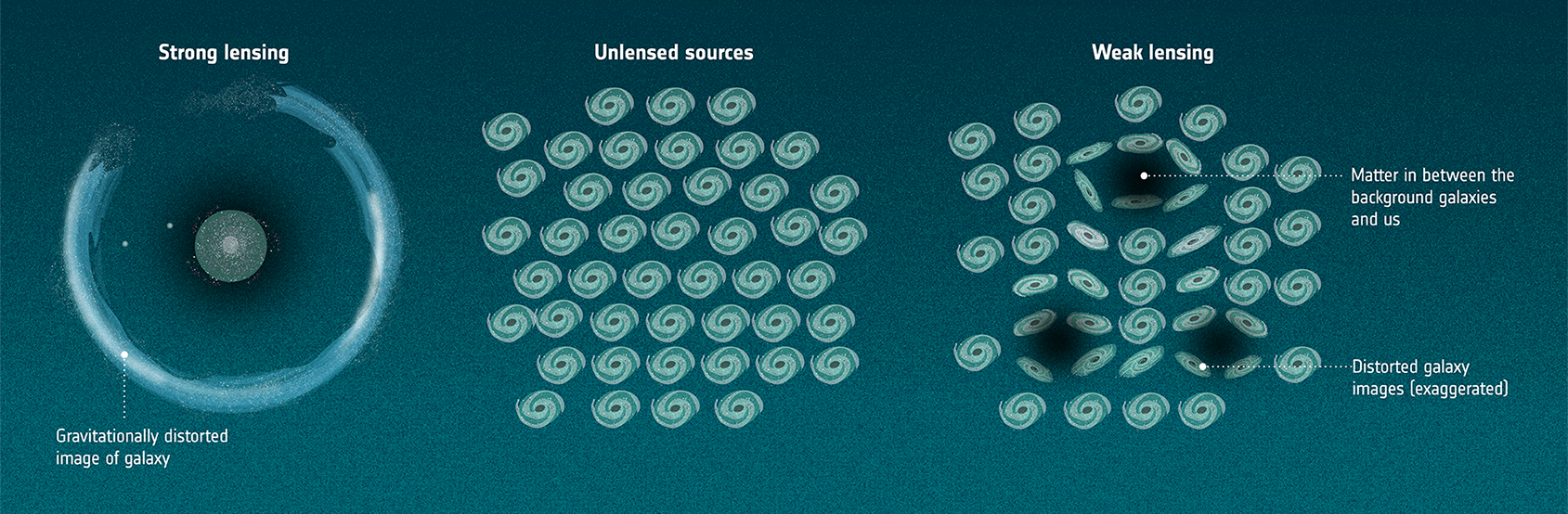
Credit: ESA
- Percent-level effect
- Polluted by shape noise
- Requires a large number of galaxies
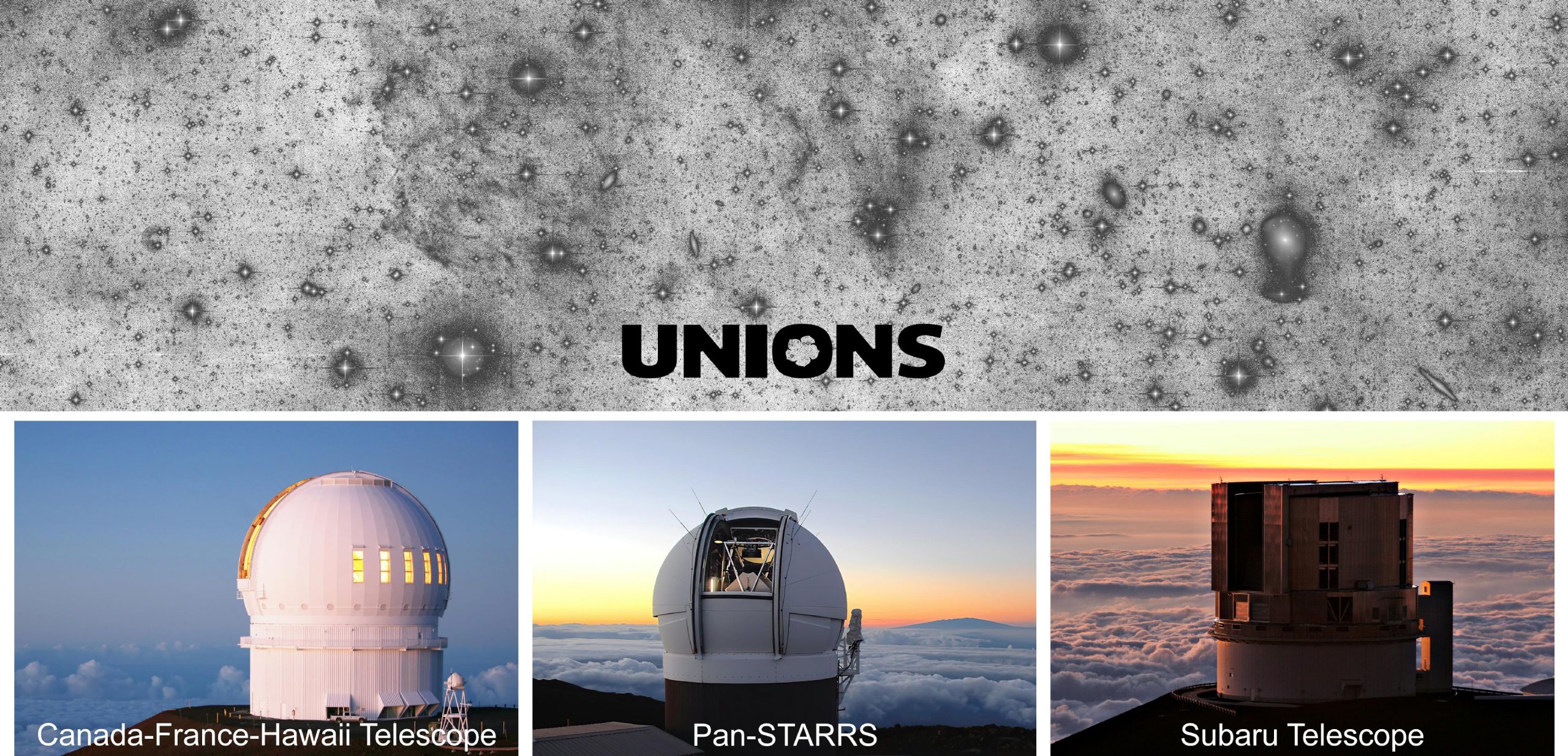
The Ultraviolet Near-Infrared Optical Northern Survey (UNIONS, Gwyn et al., 2025)
Euclid photometry in the North
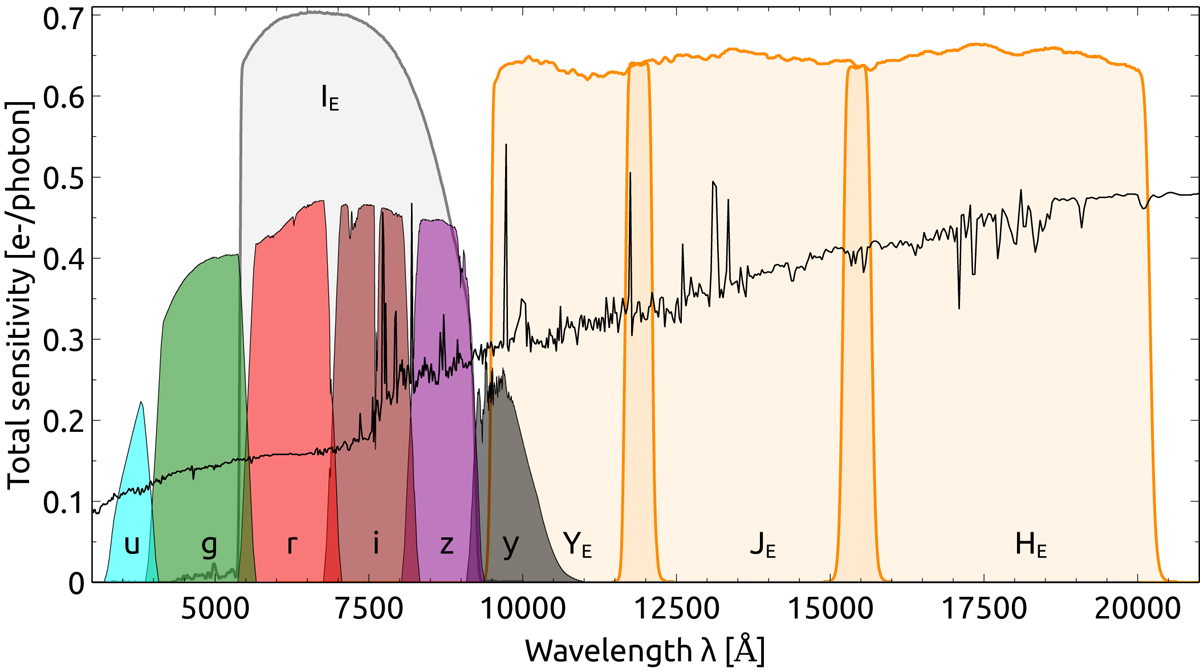
The landscape of lensing surveys
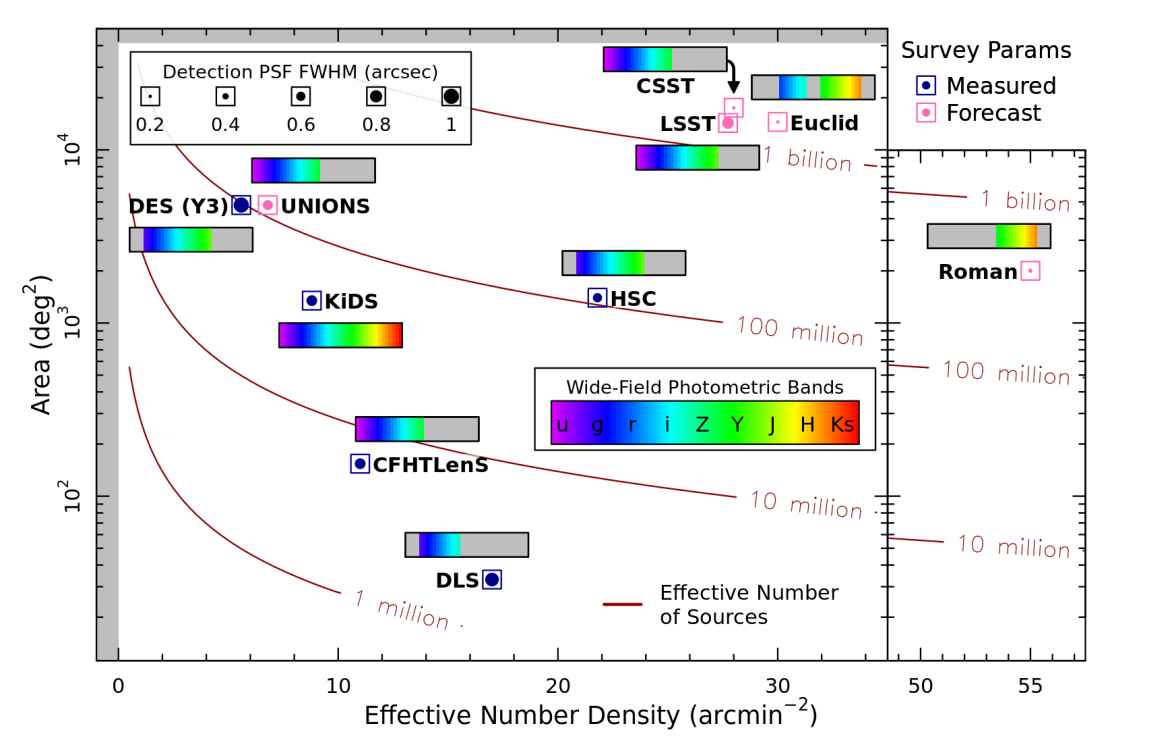
Technical specifications of UNIONS:
- Target area: \(\sim 5,000\) deg\(^2\)
- Depth: 24.5 (\(r\)-band)
- Seeing: \(\sim 0.69"\) (\(r\)-band)
- Processing with ShapePipe (Farrens et al., 2022)
- \(\sim 100\) million galaxies
Outline of the talk
- Analysis choices for our cosmic shear analysis
- \(B\)-modes null test
- Control of systematics
- PSF systematics
- Instrinsic Alignment
- Blinded constraints
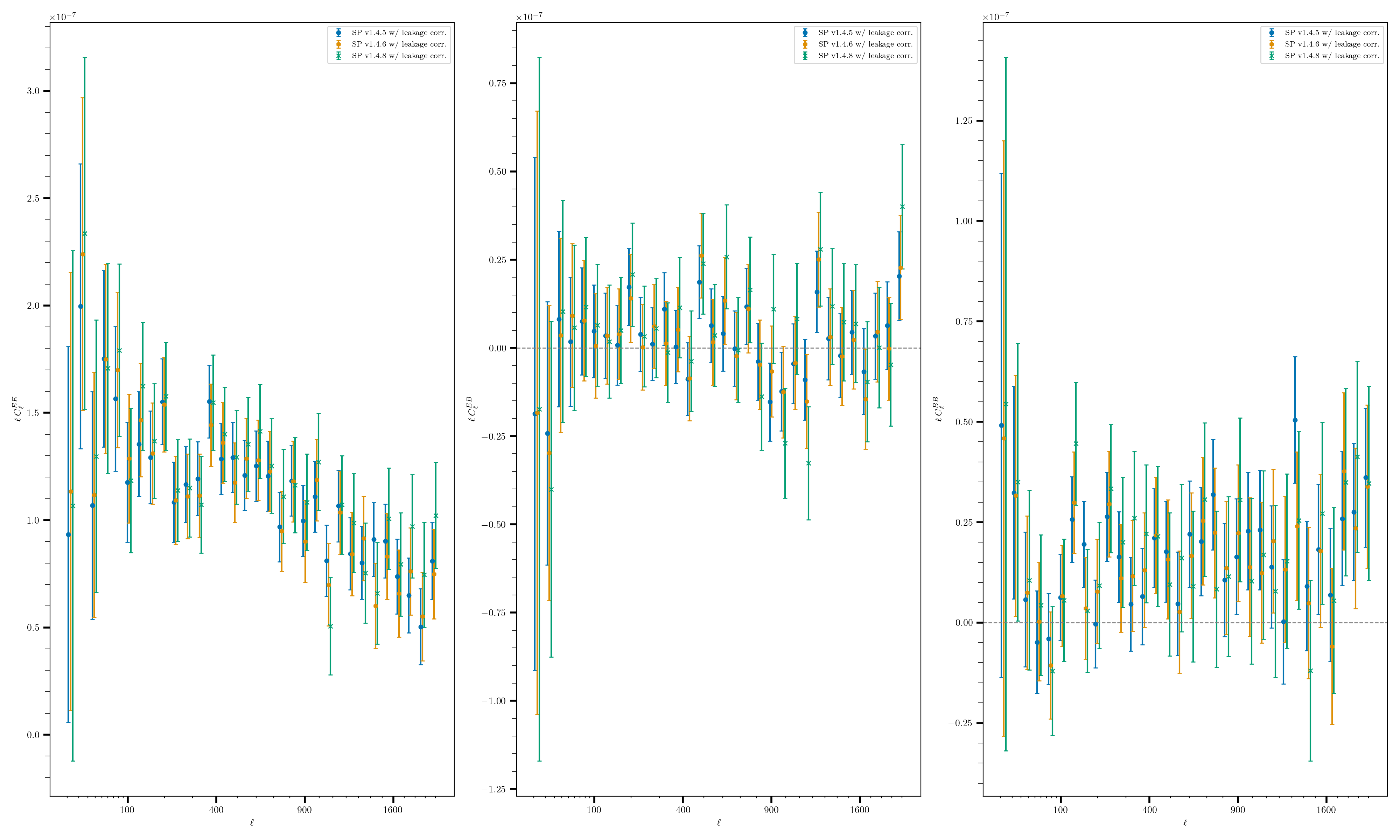
\(B\)-modes null test (harmonic space)
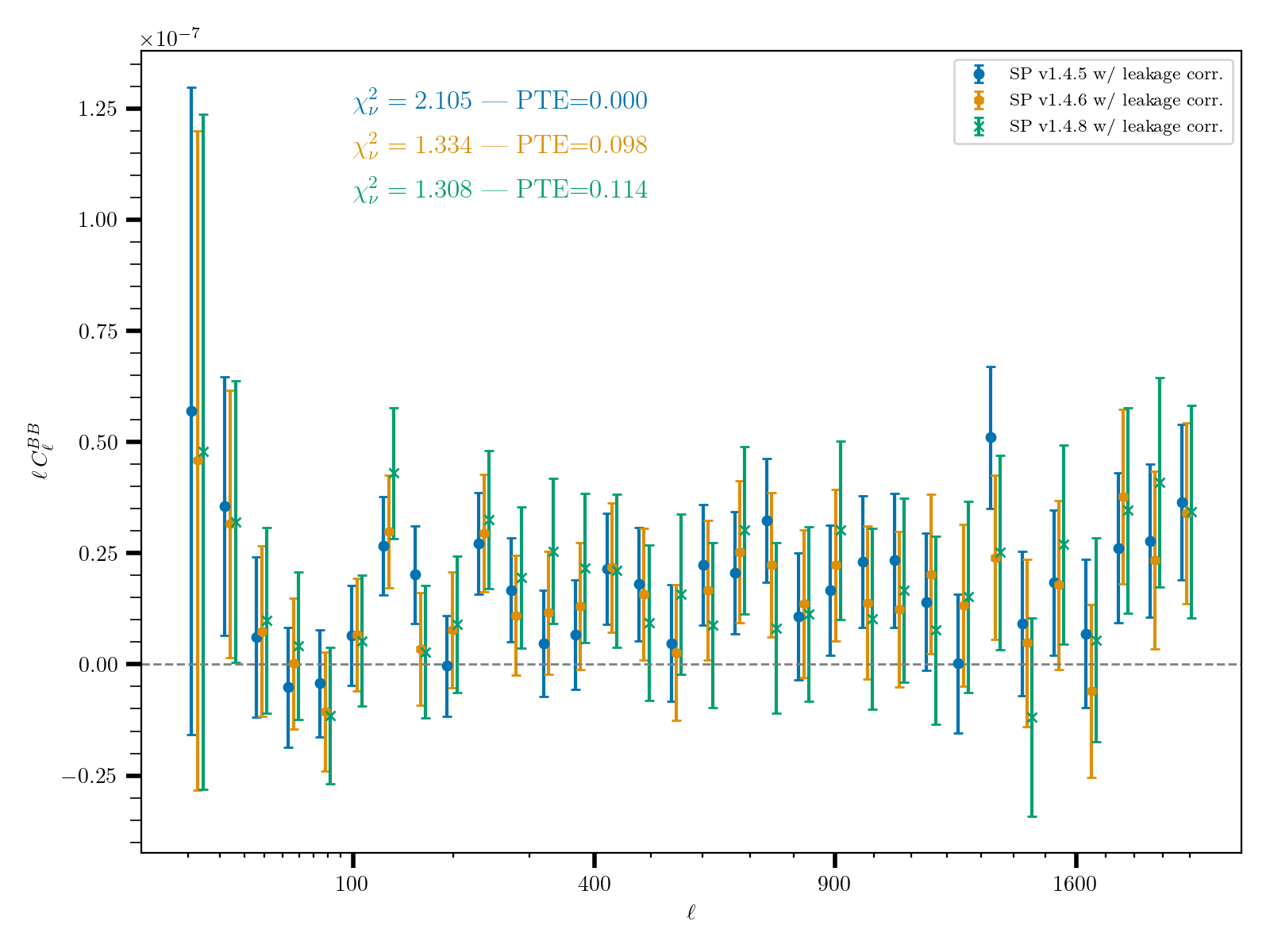
Different weak lensing catalog versions:
- SP v1.4.5: Size cut - \(\mathrm{HLR}_\mathrm{gal} / \mathrm{HLR}_\mathrm{PSF} > 0.5\)
- SP v1.4.6: Size cut - \(\mathrm{HLR}_\mathrm{gal} / \mathrm{HLR}_\mathrm{PSF} > 0.7\)
- SP v1.4.8: additionally mask star haloes
\(B\)-modes null test (configuration space)
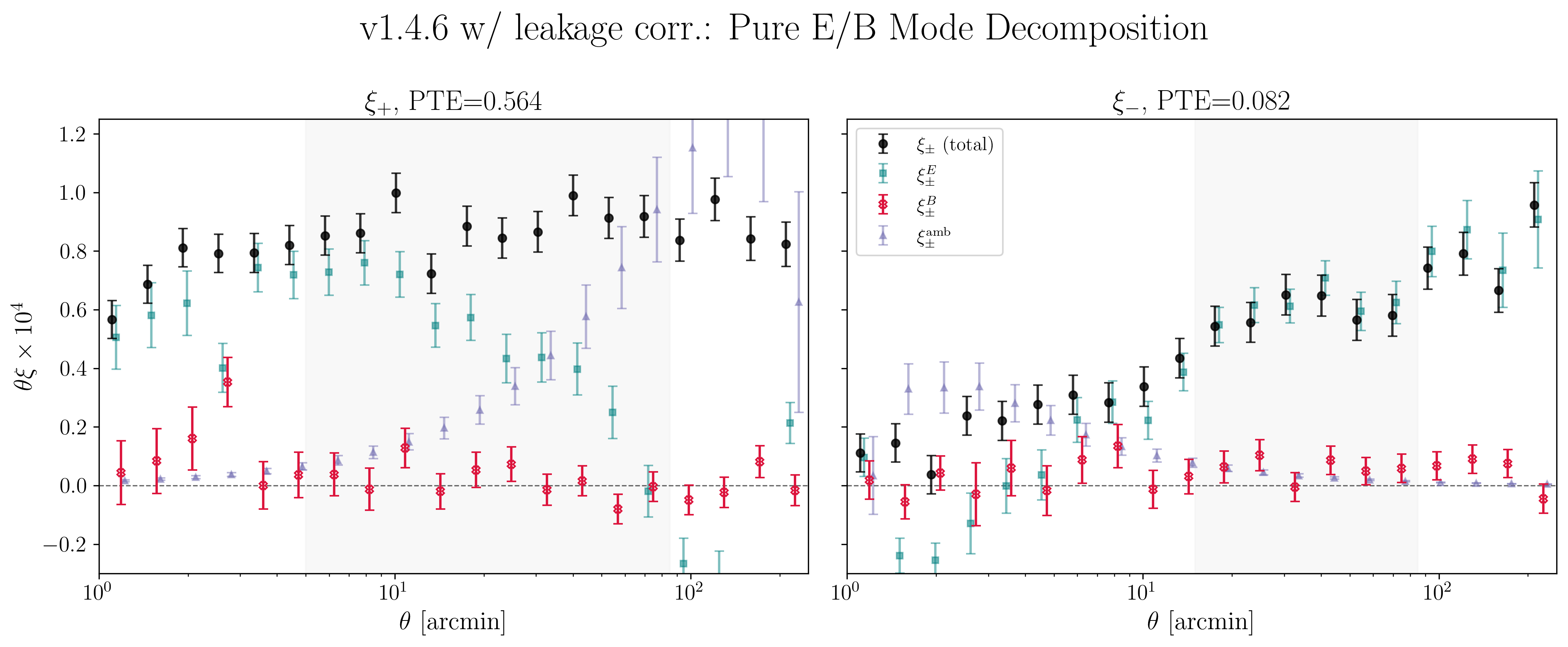
Credit: C.Daley and A.Guinot
Significant \(B\)-modes on small scales. Scale cuts on large scales derived from PSF leakage estimation.
\(B\)-modes null test (configuration space)
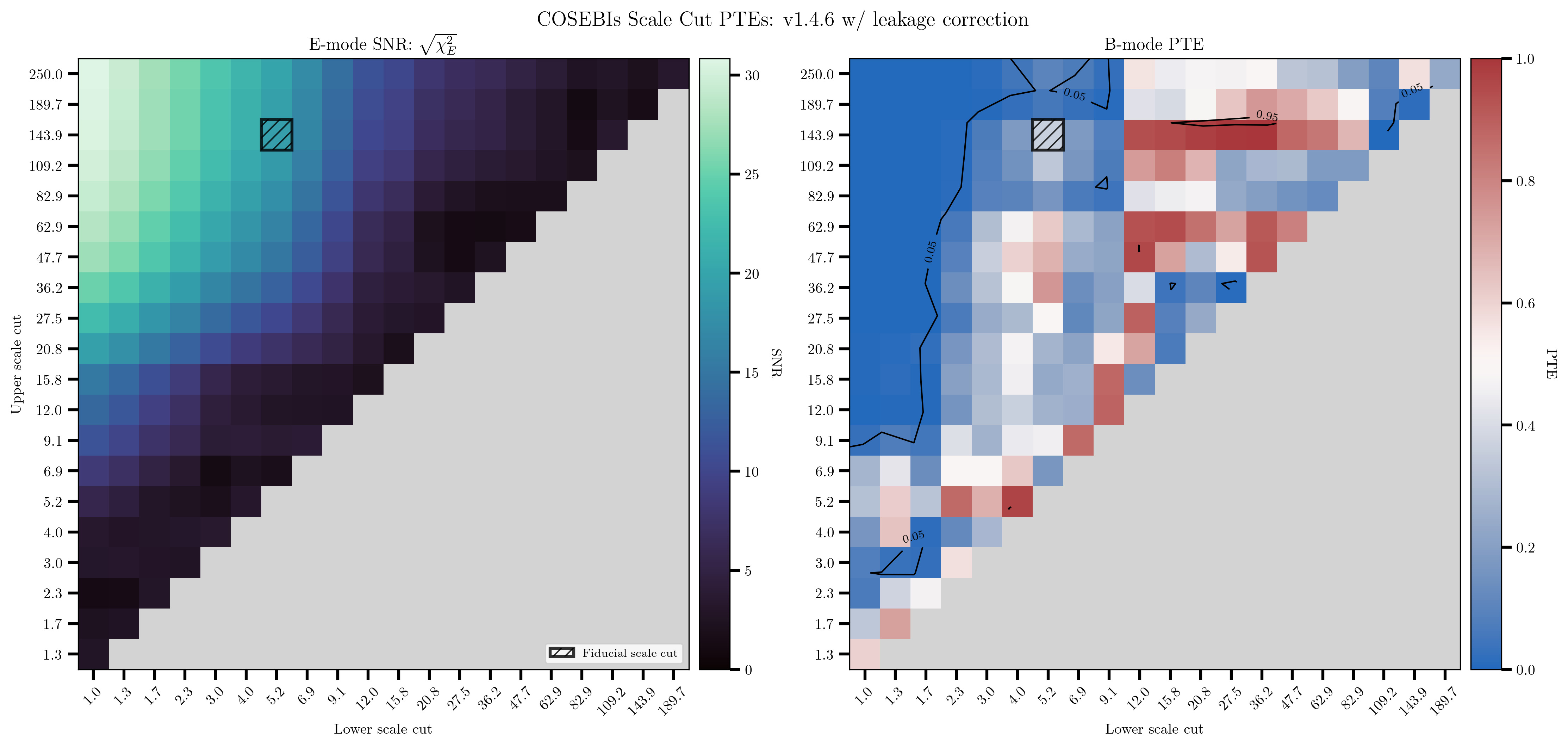
Credit: C.Daley and A.Guinot
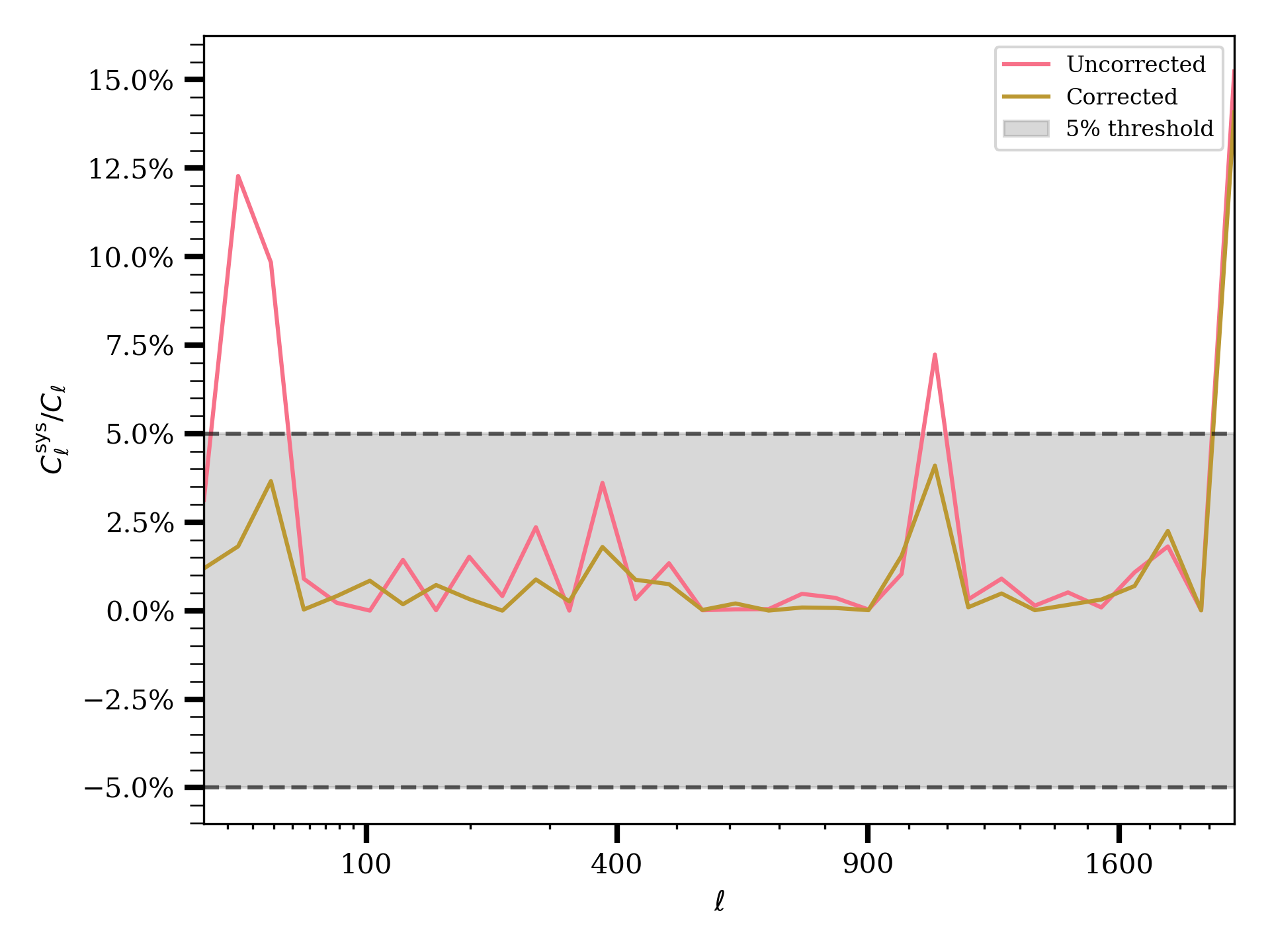
PSF systematics (Guerrini+2025)
PSF error model: \(\delta e^\mathrm{obs} = \underbrace{\alpha e^\mathrm{PSF}}_{\mathrm{leakage}} + \underbrace{\beta (e^* - e^\mathrm{PSF})}_{\textrm{ellipticity residuals}} + \underbrace{\eta e^\mathrm{PSF} \left( \frac{T^* - T^\mathrm{PSF}}{T^*}\right)}_{\textrm{size residuals}}\)
Galaxy-Star correlations: \(\tau_0(\vartheta) = \langle e^\mathrm{obs} e^\mathrm{PSF} \rangle(\vartheta)\), \(\tau_2(\vartheta) = \langle e^\mathrm{obs} \delta e^\mathrm{PSF} \rangle(\vartheta)\), \(\tau_5(\vartheta) = \langle e^\mathrm{obs} \delta T^\mathrm{PSF} \rangle(\vartheta)\)
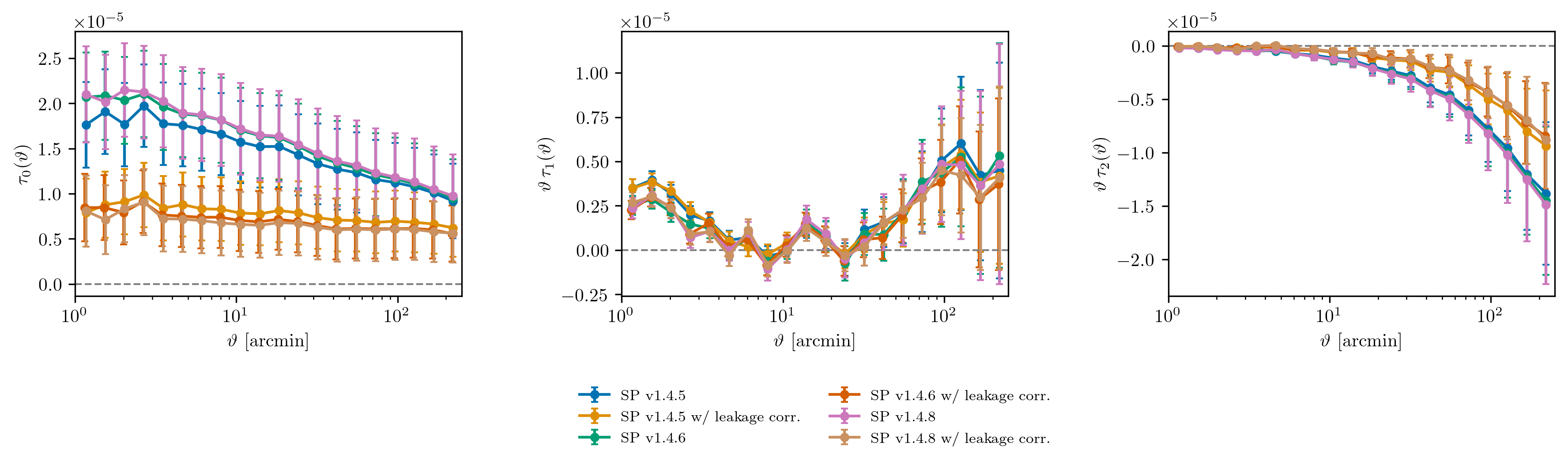
PSF systematics (Guerrini+2025)
Galaxy-PSF correlation helps to:
- Select our weak lensing sample
- Choose scale cuts for the inference
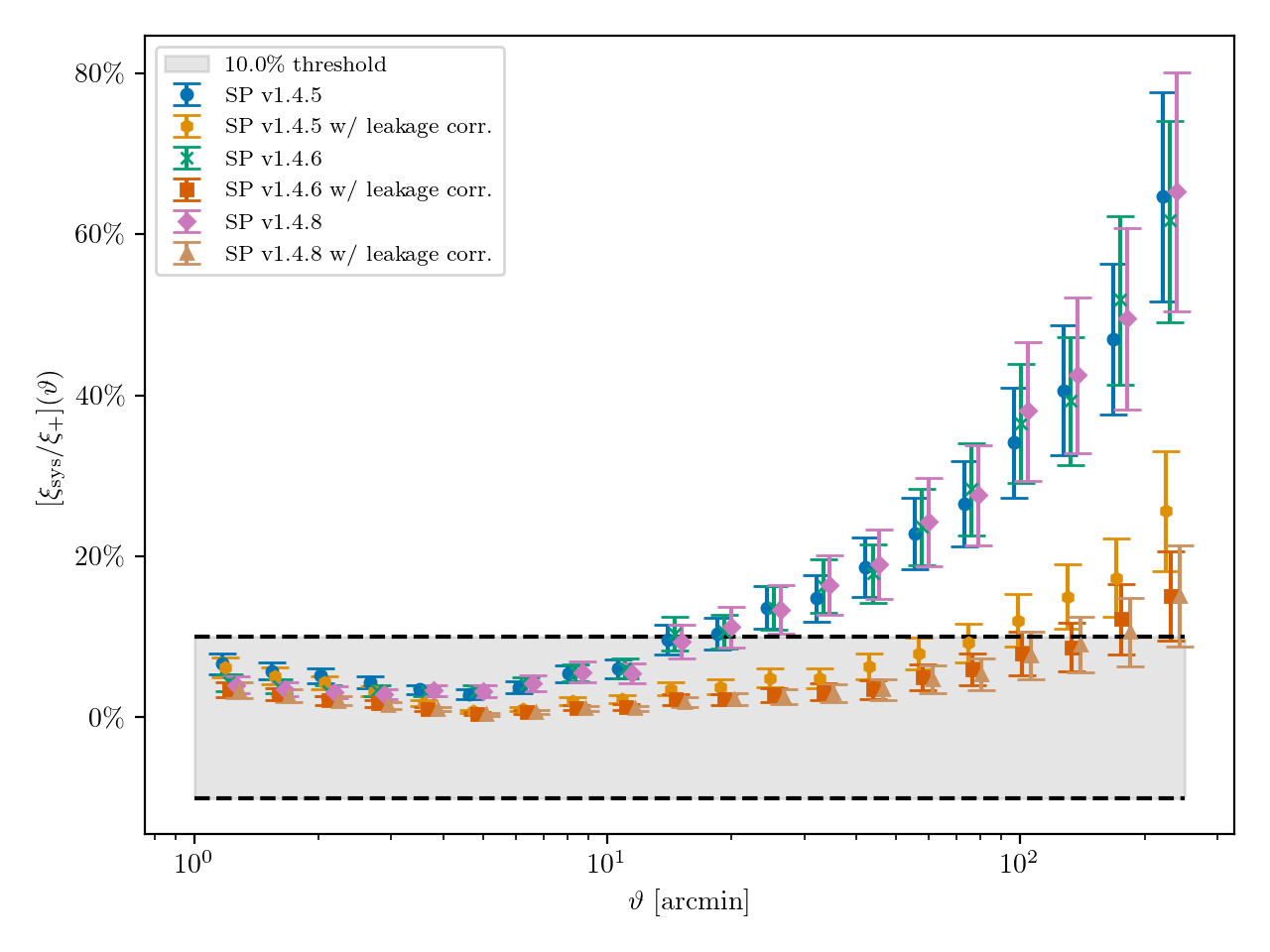
\[ \xi_\mathrm{sys}(\vartheta) = \alpha \tau_0(\vartheta) + \beta \tau_2(\vartheta) + \eta \tau_5(\vartheta) \]
Intrinsic Alignment
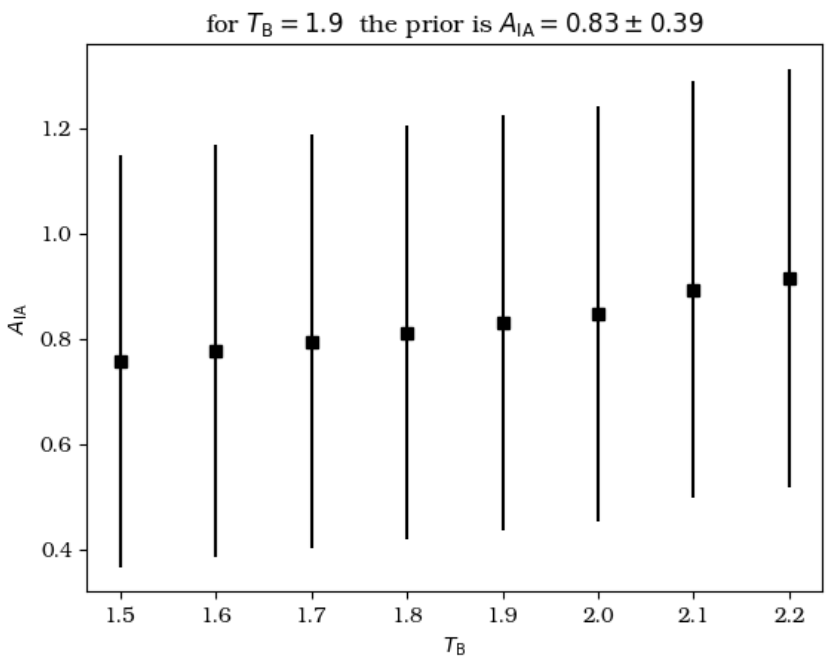
In a non-tomographic setup, \(S_8\) and \(A_\mathrm{IA}\) are strongly degenerate.
\[ A_\mathrm{IA} = f_\mathrm{r} A_\mathrm{IA, r} + f_\mathrm{b} A_\mathrm{IA, b} \]
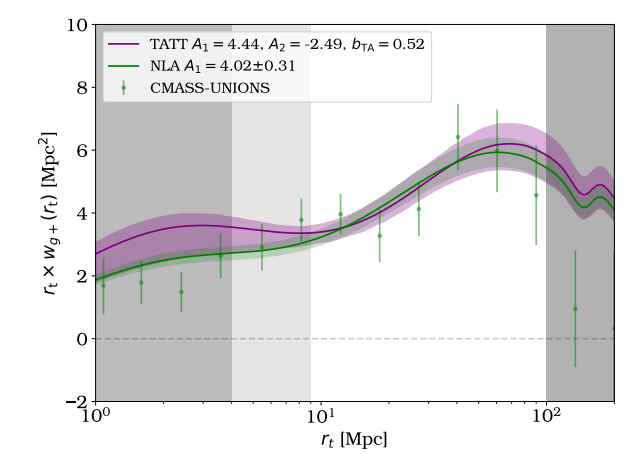
Direct measurements can be used to derive a prior for different galaxy types.
Intrinsic Alignment
- Separate red and blue galaxies.
- Estimate red and blue fractions.
- Estimate \(A_\mathrm{IA, b}\) from direct measurement (Johnston+2019).
- Estimate \(A_\mathrm{IA, r}\) sampling from IA/luminosity relationship.
- Add Gaussian errors in quadrature.
- Doubling the width of the prior to be conservative.
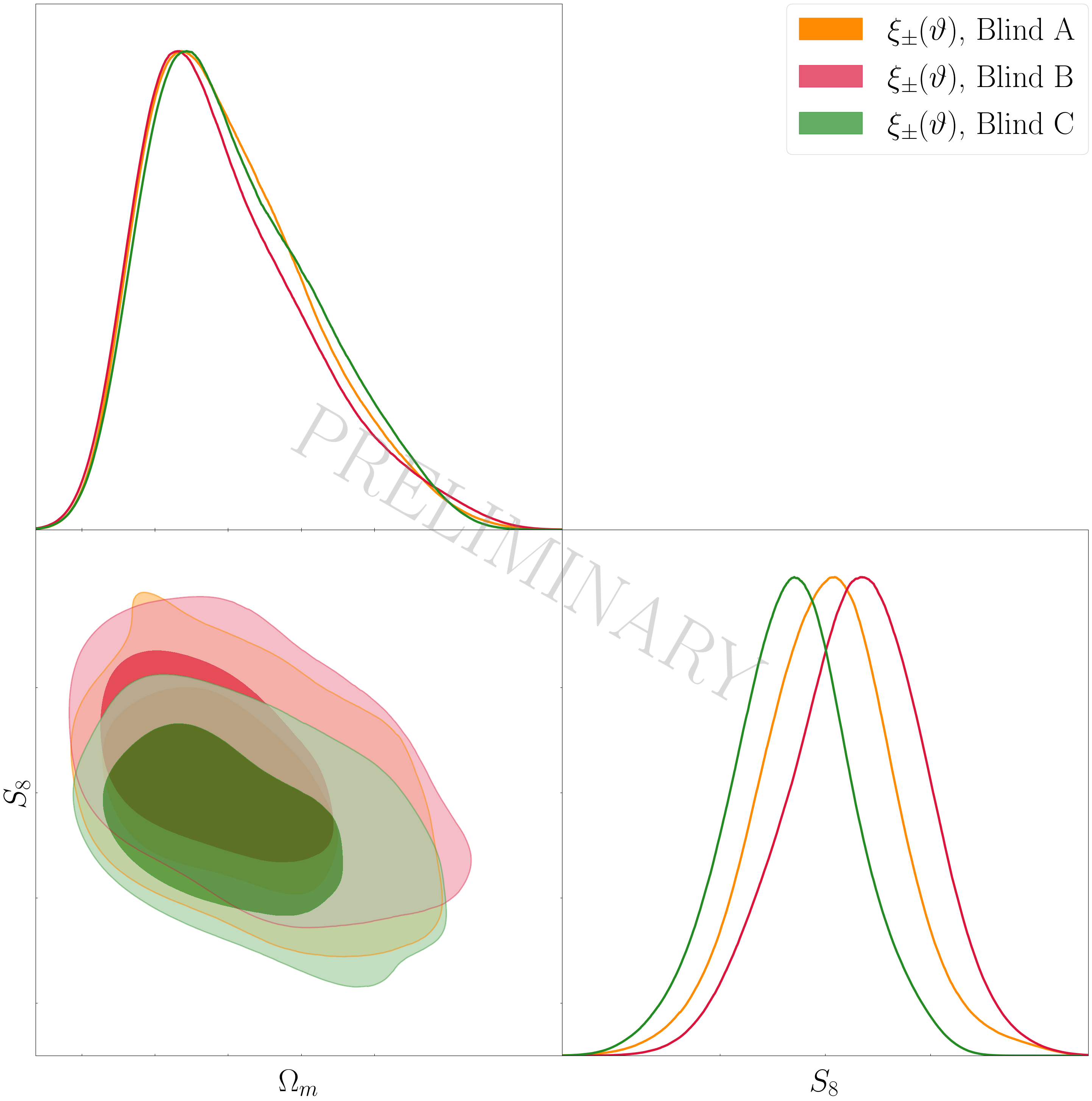
Blinded constraints
Analysis blinded by the use of 3 different redshift blinds.
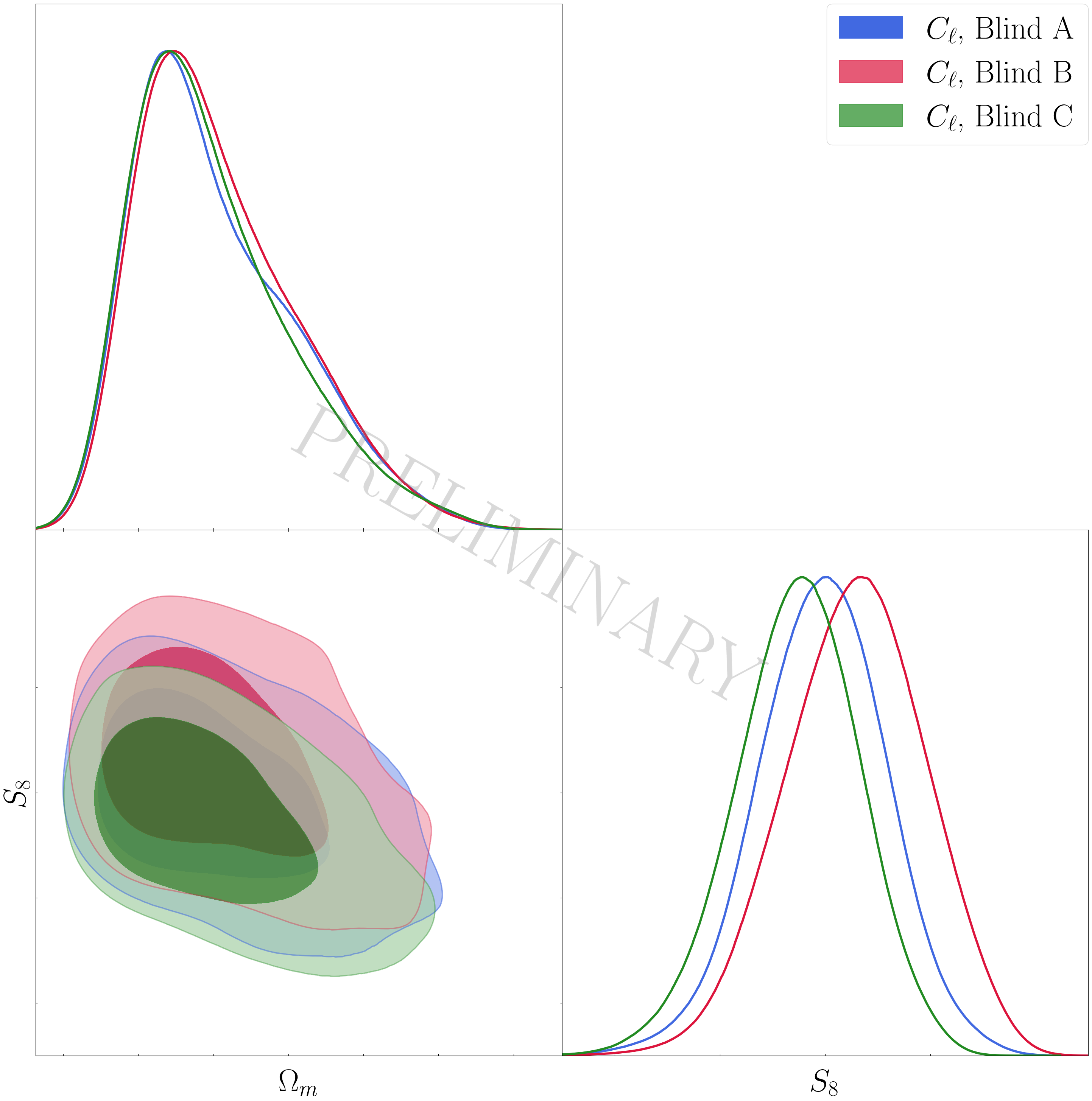
Blinded constraints (harmonic space)
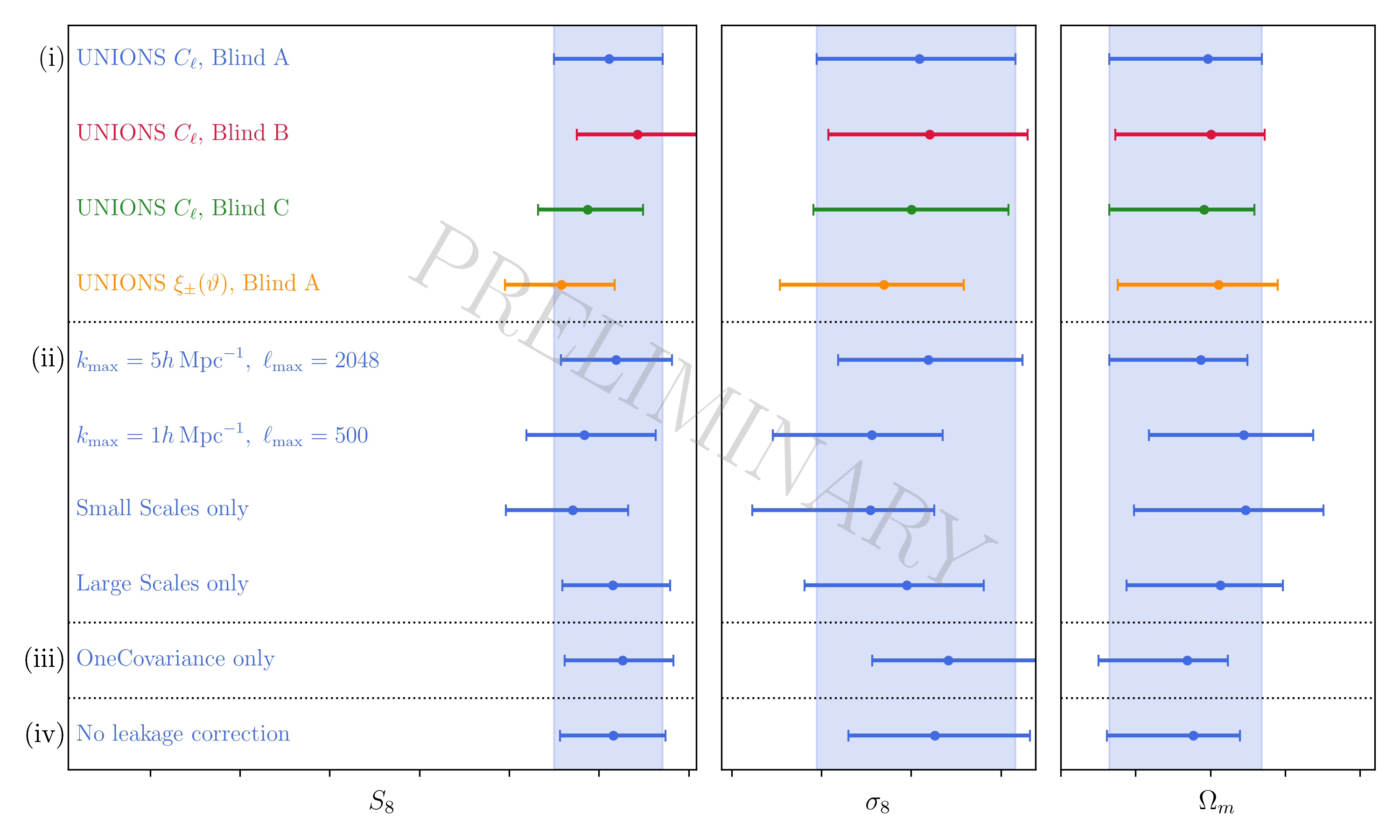
Guerrini+in prep.
Blinded constraints (configuration space)
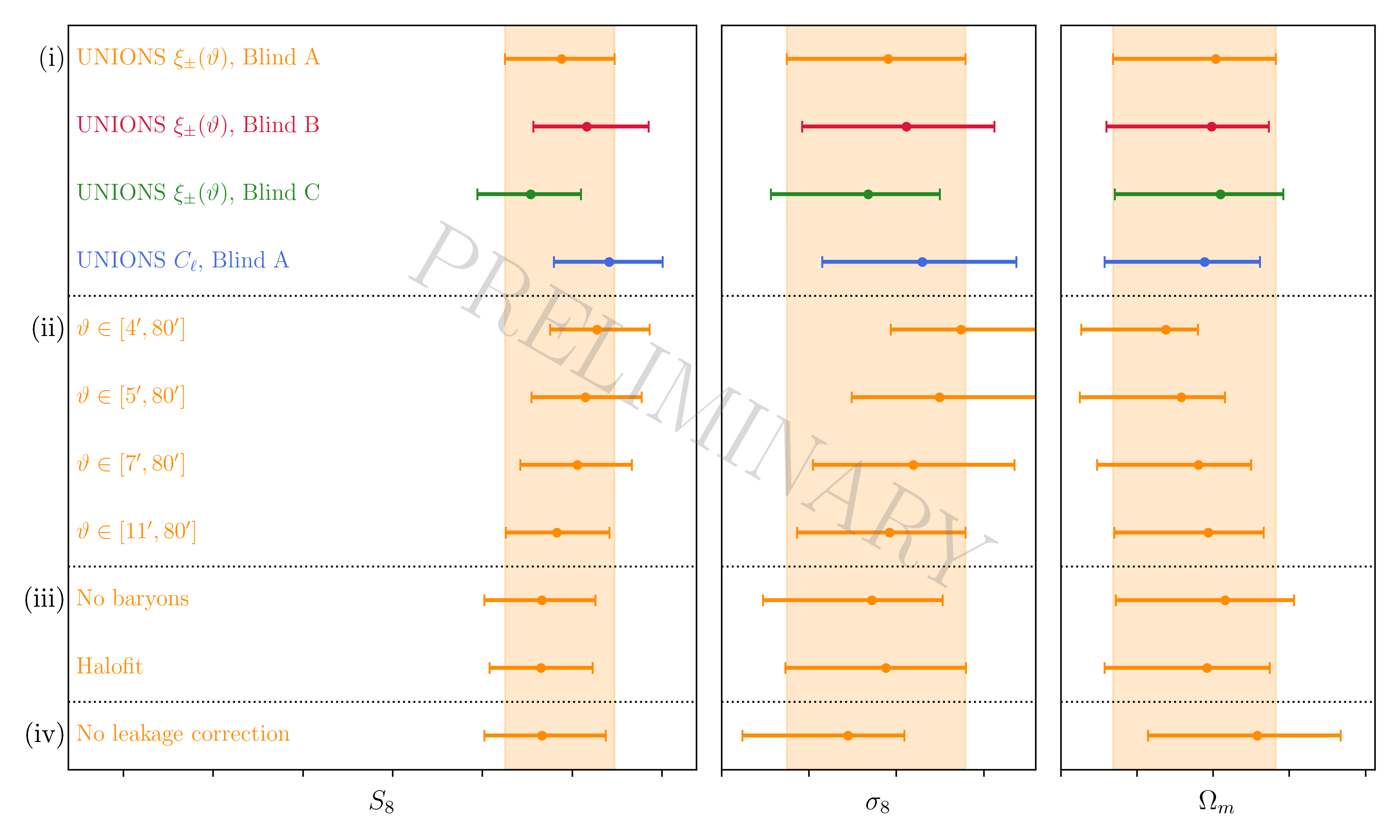
Goh+in prep.
Shear \(m\)-bias
\(m\)-bias corrected with MetaCalibration. Further calibration required from image simulations due to blending.
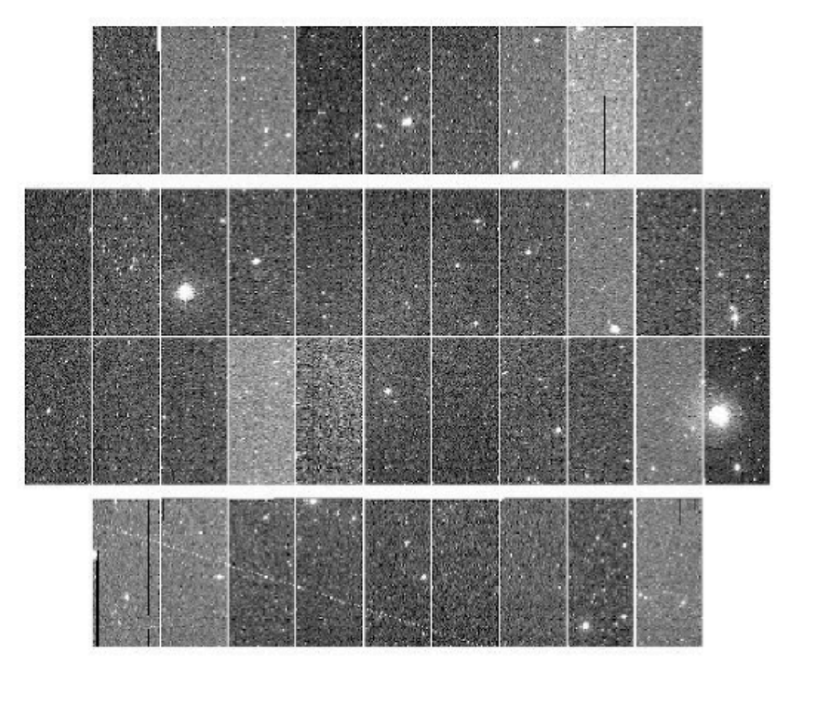
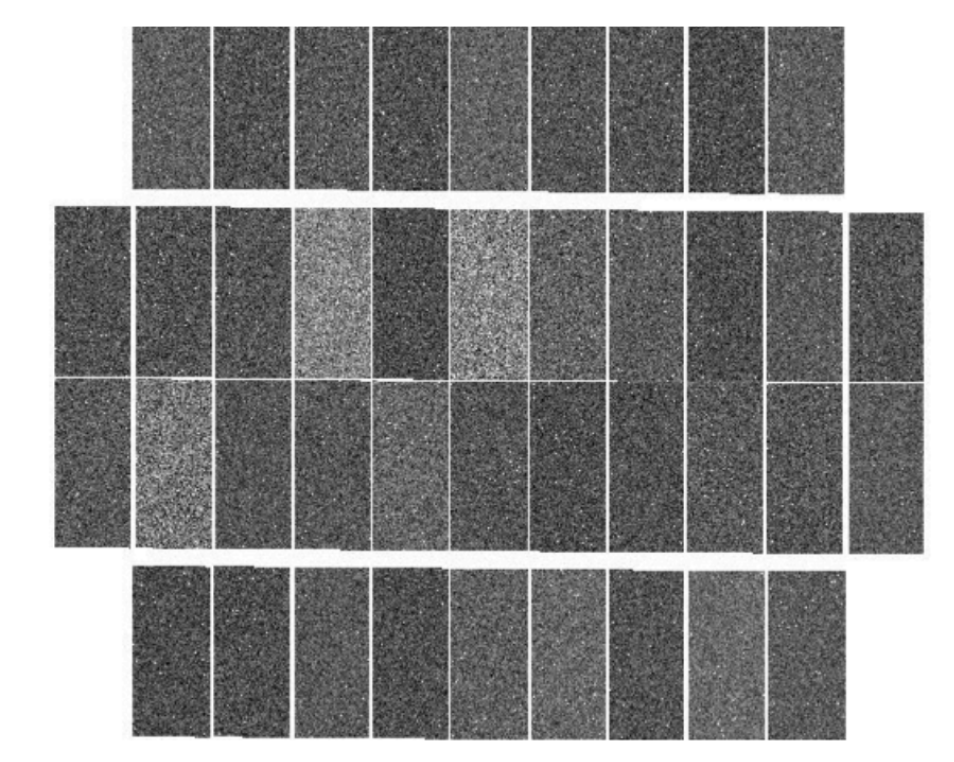
Hervas Peters+in prep.
Redshift distribution uncertainty
Analysis blinded by the use of 3 different redshift blinds.
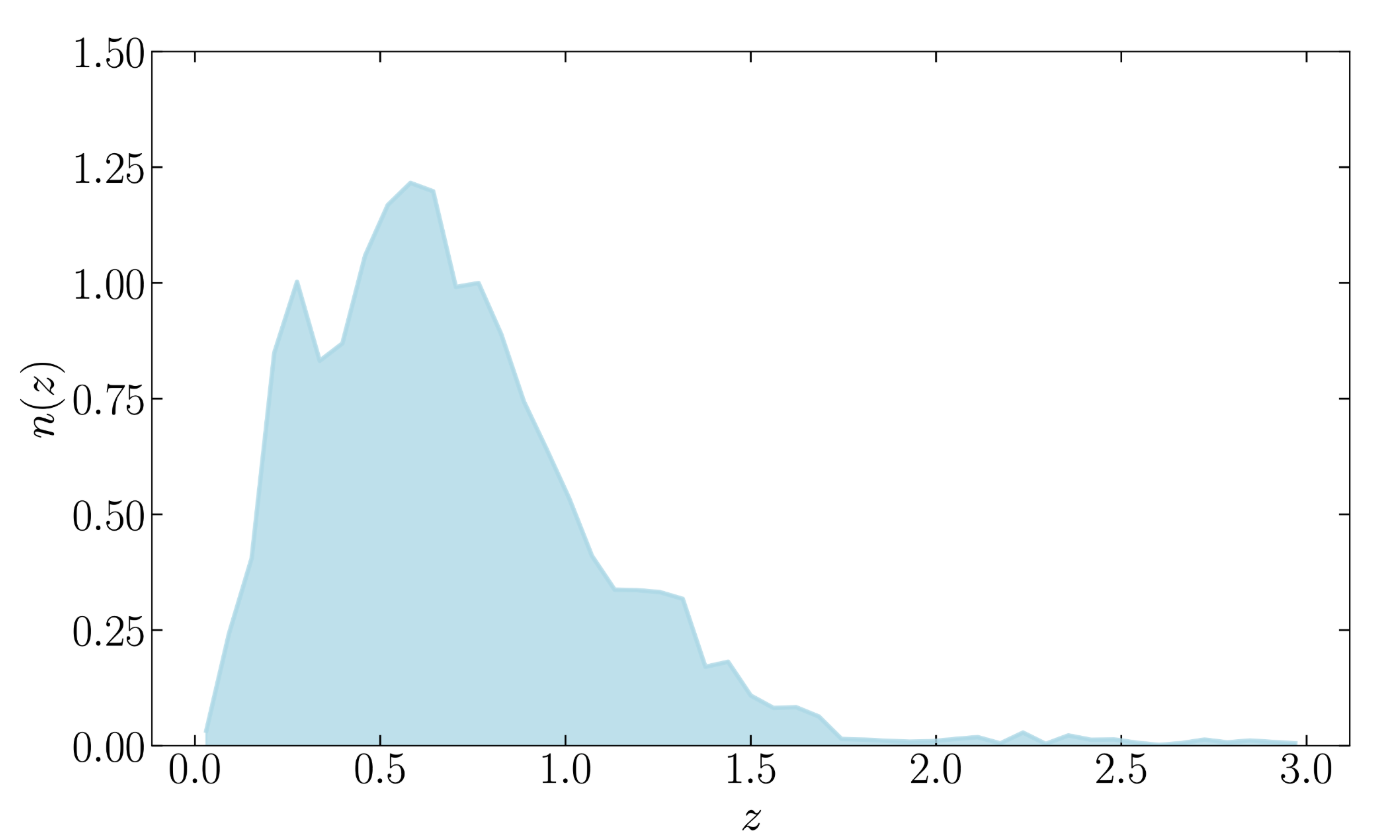
Credit: A.Wittje
PSF systematics (harmonic space)
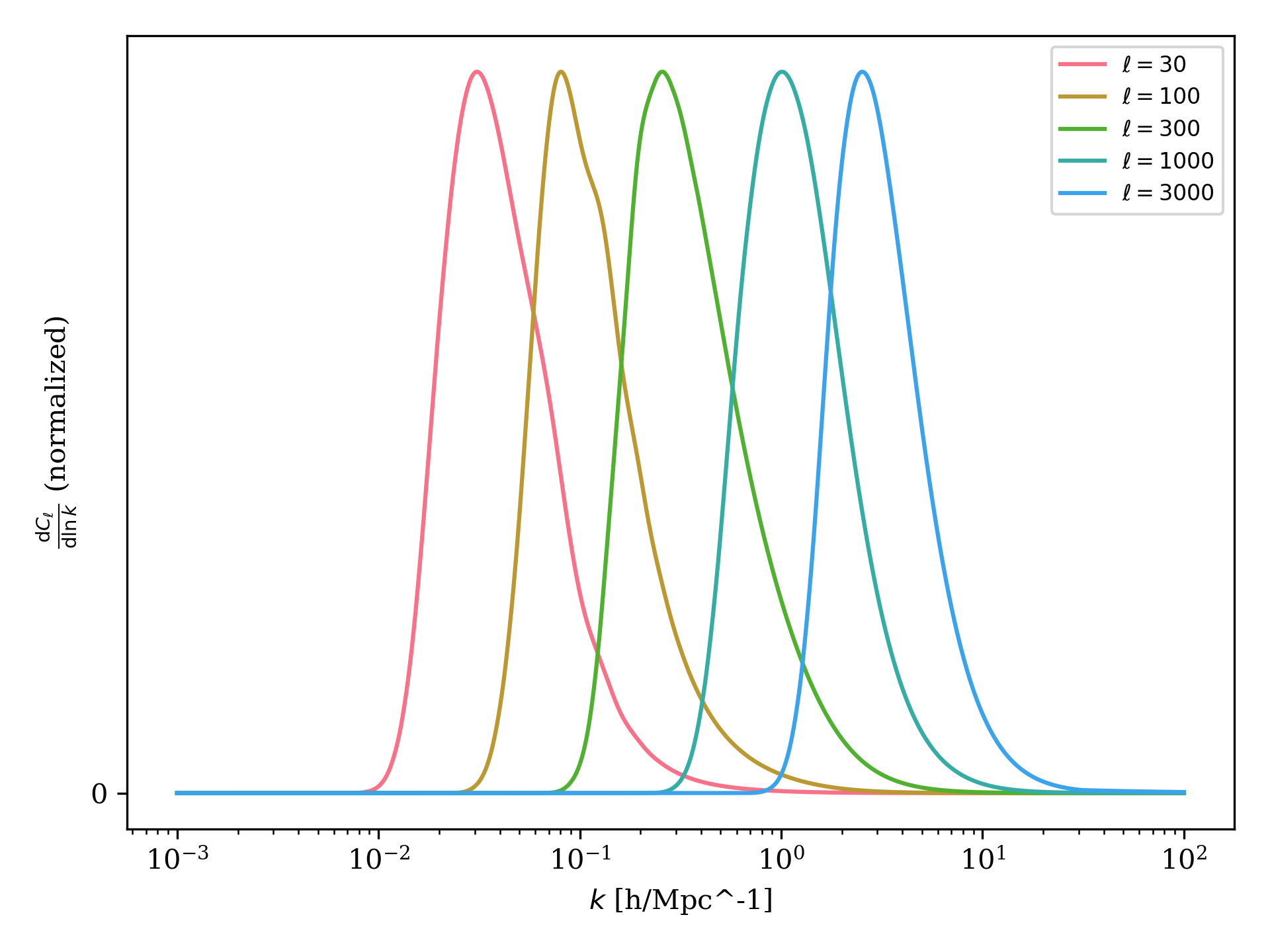
Scale cuts (harmonic space)
Data vector (harmonic space)
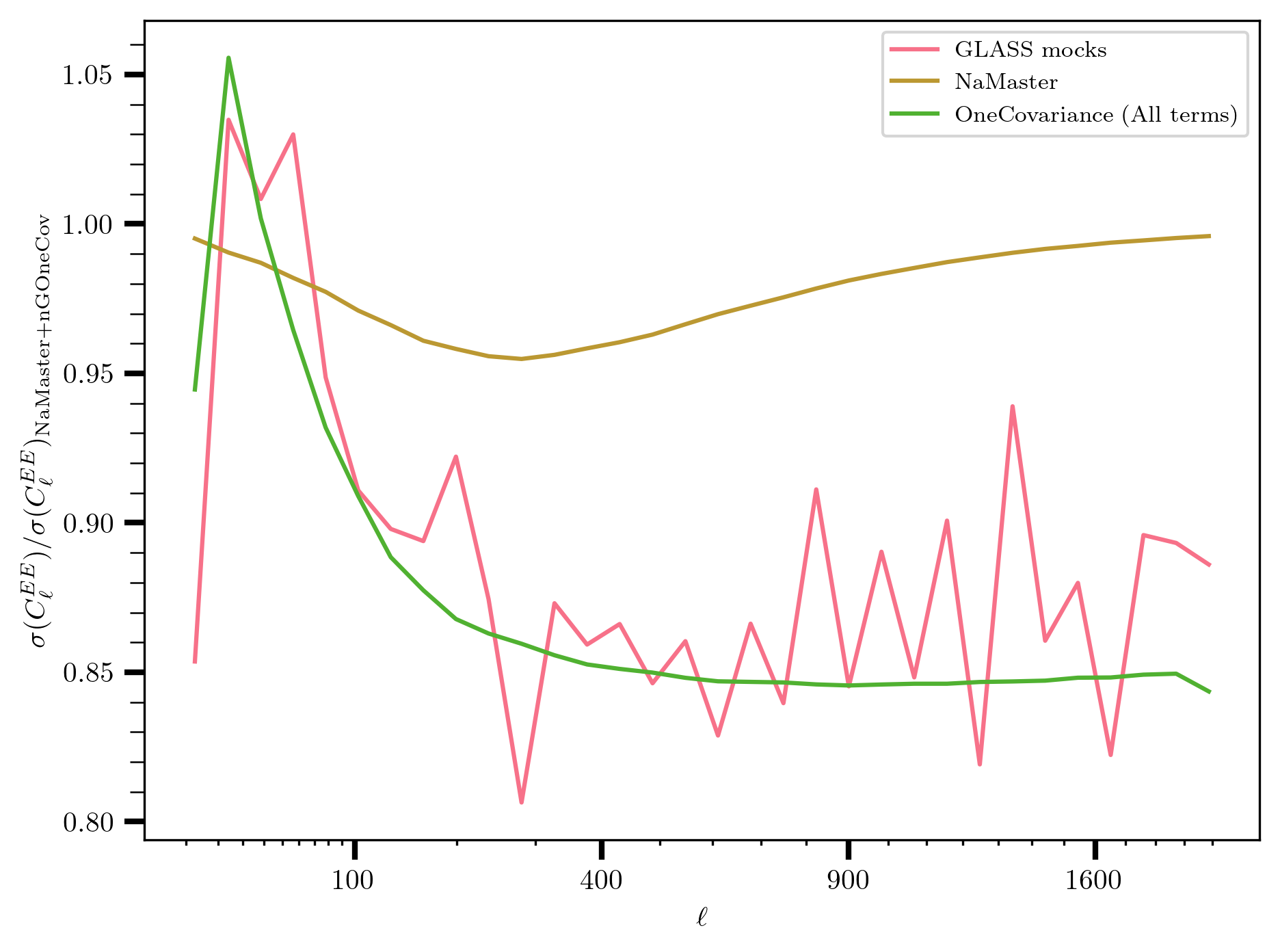
Covariance validation (harmonic space)